
Access most of the above features right from your desktop. IVS Email, IVS Documents and IVS Calendar
ivslogo  


The Foundation Programme cultivates fundamental habits and attitudes that are expected to remain with the students throughout their studies. The overall approach in the first year is one that provides both a demanding pace of work and discipline yet encourages self-reliance, responsibility towards studies and an attitude of focused enquiry.

This is an integrated programme dealing with fundamental issues relating to the studies of visual arts. It aims to heighten perceptions and build awareness through the introduction of concepts relating to visual creativity. The structure of the curriculum encourages critical thinking, individual development and personal direction whilst assuring exposure to numerous approaches, media, methods, techniques and processes. This is achieved through studio practice organized around projects that are integrated, sequential and increase in complexity.

This thorough grounding in the broad underlying concepts and principles of the visual arts, before specialization, encourages flexibility, adaptability and the capacity for continuity of the creative process. Drawing is considered the fundamental tool for all art and design disciplines and this is reflected in the curriculum. The weekly rotation of studies ensures the maximum integration of all learning opportunities in the year. During the year, great emphasis is placed on time management. A portfolio review takes place twice a year and here the students are also counselled on their overall progress. 

Overview

The Foundation programme cultivates fundamental habits and attitudes that are expected to remain with the student throughout his/her studies. The overall approach in these two semesters is one that provides both a demanding pace of work and discipline yet encourages self-reliance, responsibility towards studies and an attitude of focused enquiry.

This is an integrated programme dealing with fundamental issues relating to the studies of visual arts. It aims to heighten perceptions and build awareness through the introduction of concepts relating to visual creativity. The structure of the curriculum encourages critical thinking, individual development and personal direction whilst assuring exposure to numerous approaches, media, methods, techniques and processes. This is achieved through studio practice organized around projects that are integrated, sequential and increase in complexity.

This thorough grounding in the broad underlying concepts and principles of the visual arts, before specialization, encourages flexibility, adaptability and the capacity for continuity of the creative process. Drawing is considered the fundamental tool for all art and design disciplines and this is reflected in the curriculum. The weekly rotation of studies ensures the maximum integration of all learning opportunities in these two semesters. During foundation studies, great emphasis is placed on time management. A portfolio review takes place at the end of each semester and here the student is also counselled on his/her overall progress.


Curriculum

FIRST SEMESTER  (20 Credit Hours)
(For Architecture and Interior Design Students) (19 Credit Hours)


LA 105     History of Art                            
LA 106     History of Cultures              
LA 110     Study Skills                  
LA 111     City Orientation               
FA 101     Drawing                           
FA 102     Materials and Processes 
DE 102    Basic Design                    
AR 105    Architectonics                 
AR 108    Communication Skills      
FD 101     Seminar                           


SECOND SEMESTER  (20 Credit Hours)
(For Architecture and Interior Design Students) (19 Credit Hours)

LA 205     History of Art                  
LA 206     History of Cultures         
LA 210     Study Skills                      
LA 211     City Orientation               
FA 201     Drawing                           
FA 202     Materials and Processes 
DE 202     Basic Design                    
AR 205     Architectonics                 
AR 208     Communication Skills     
FD 201     Seminar                           

Important | Curricula, courses and course outlines are continuously under review. The Indus Valley School reserves the right to alter, substitute, eliminate from or add to the list of courses and details at any time without notice.


Courses

DRAWING
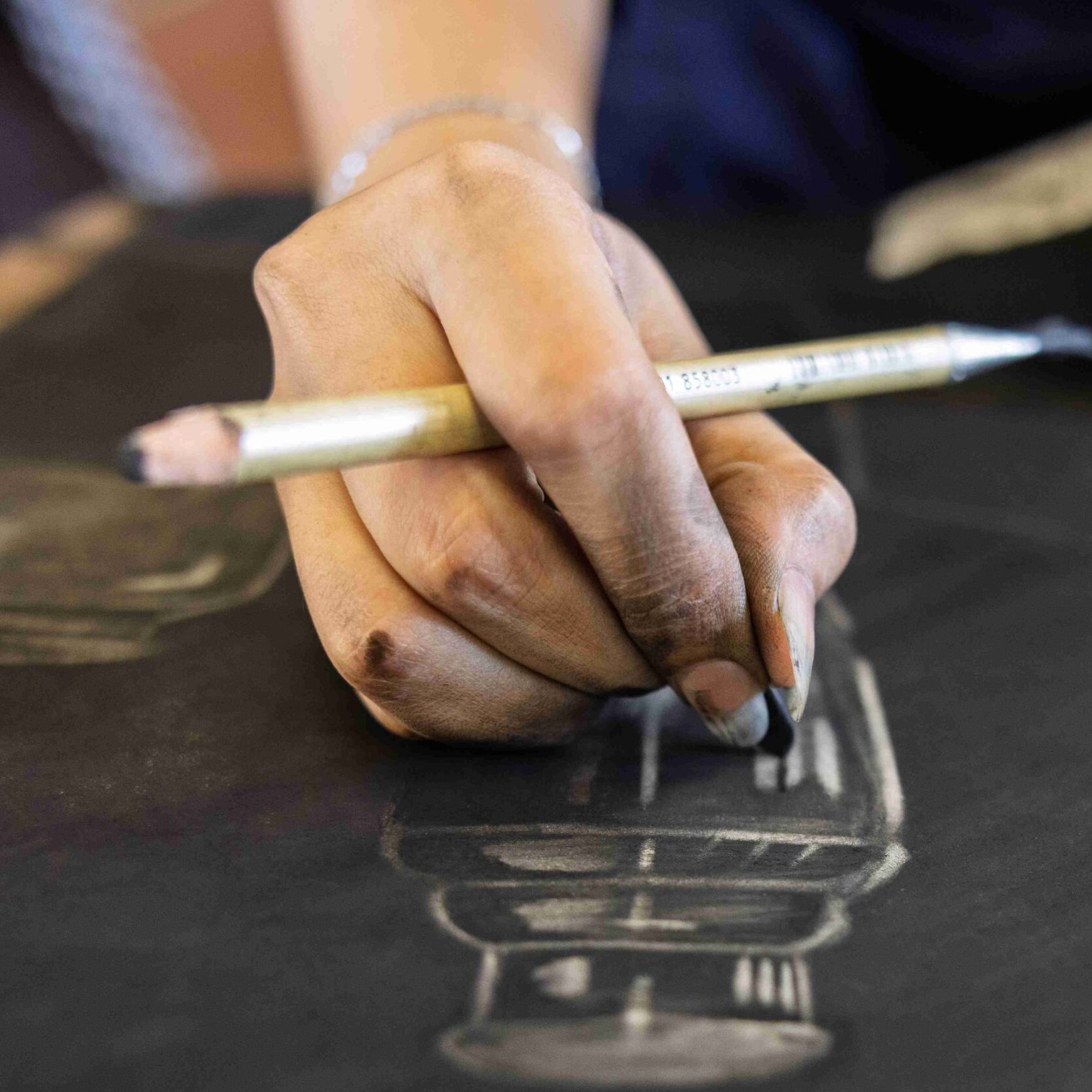
This course seeks to introduce students to the technicalities of drawing, through the proper use of a pencil and exploring the flexibility of their wrists and fingers for fluid drawing. By the end of the first semester, students will be expected to translate three-dimensional information into two-dimensional space, by learning how to plot, locate and add volume. They will be exposed to various mediums of drawing through the study of different surfaces and texture by using organic forms as well as mechanical objects. The year will see students introduced to the concepts of texture, depth and space. Students will complete outdoor assignments as well as those relating to the human figure, active environments, light, close-ups and transformation.

BASIC DESIGN
This course seeks to develop technical expertise and conceptual growth through a series of structured problems. These exercises are organized in a manner to give students room to experiment analytically and intuitively. They are introduced to the elements and principles of design which are line, texture, form, value, colour and negative-positive spatial relationships, balance, rhythm, proportion, unity and harmony. These concepts are developed through visual activities which include but are not limited to creating compositions with lines and shapes, designing a unit that is repeated and arranged in different ways to make a composition or border, creating texture with different mediums, studying the metamorphosis of shapes and objects.

COMMUNICATION SKILLS
This course seeks to inculcate the understanding of two and three-dimensional representation of built form. It begins with the study of the basic cube and pyramid form leading to general household items and further on to buildings. Initiation into this programme is done through an introduction to various instruments and methodologies. Students are expected to master the concepts of plan, elevation, section and its three dimensional representation in axonometric.  They are taught one and two point perspective in free hand as well as with drafting tools. To have a feel for the tools and pencils they are taught to use the T-scale and setsquare together, to align the sheet and draw lines of different widths and intensities. Students are also actively encouraged to express their vision through models so that they can refine their technical skills.

MATERIALS AND PROCESSES
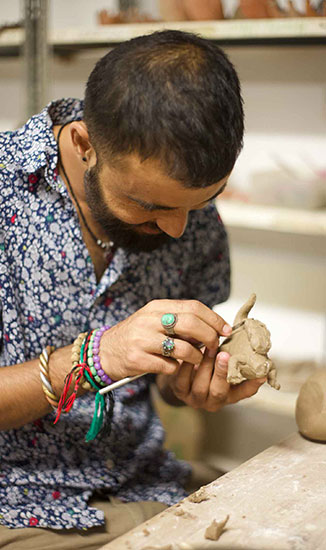
This course aims to give a fundamental exposure to three-dimensional work. It not only raises technical awareness but also enables the students to look at the human-made world around them and to begin to understand it with greater insight. The materials that are explored in this course are clay, plaster of Paris, wood and metal and a number of working processes associated with them. In addition to this, the course seeks to provide students with field experience and includes assignments that involve realization of a concept from the sketch book to the material.

TECHNICS
The course is geared towards a broader conceptual understanding of the basic principles of design. This can be achieved by understanding the linkages between art, design and architecture. These linkages can be seen in the abstract and real concepts of space, in reference to the human scale. Euclidian geometry is discussed. A basic understanding of geometric form in 2D or polygons, and 3D or polyhedra, regular and irregular is established. In polyhedra, platonic and non-platonic forms are discussed and constructed. Structure is broken down in three topics: geometrical, functional, and static. Consideration is also given to the physical and structural properties of materials. Modern and contemporary architects are briefly discussed in light of the “form vs. function” debate. Stress is placed on precise and effective visual, verbal, and written communication.

STUDY SKILLS
This is an intensive course designed to develop reading, writing and research skills. It includes regular written assignments and equips students to deal with theory course requirements at the school.

STUDENTS WEEK
A Students’ Week is an important part of the Foundation Programme and is held at the end of the Spring and Fall Semesters.

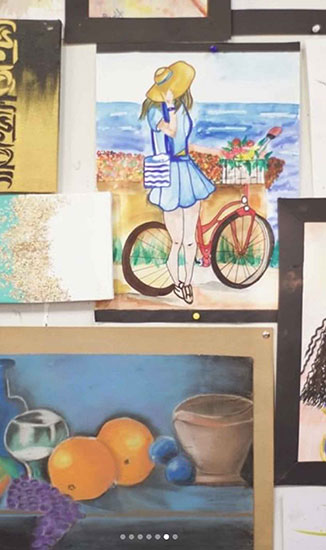
STUDENTS WORK DISPLAY
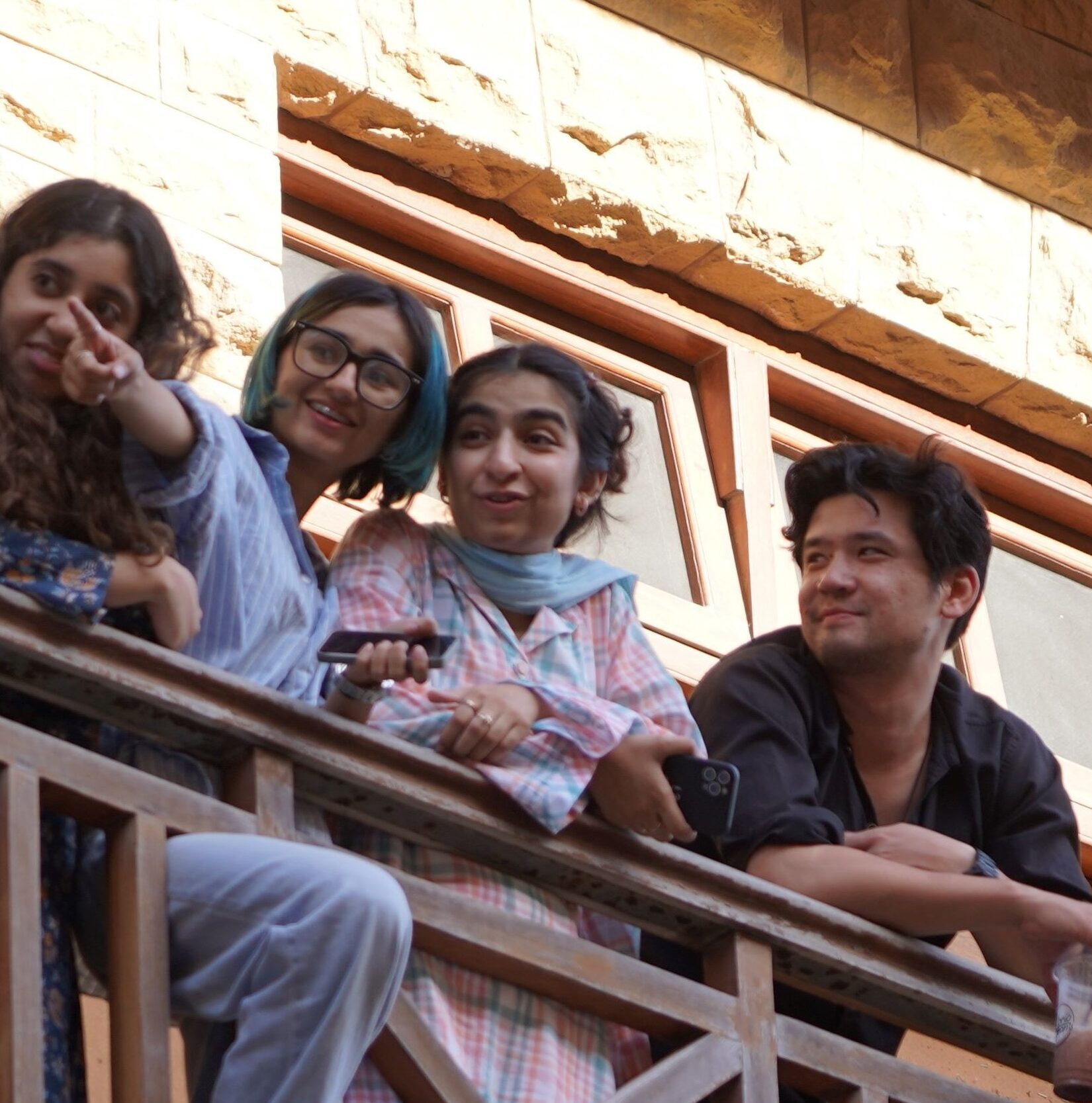
This is an important, Bi annual event of the Foundation Programme, where all the work done by the FP students in their studios, is displayed, and their parents, families, and friends are invited to see their work.

PORTFOLIO REVIEW
Students portfolios are reviewed once in the Spring and Fall Semesters and teachers counsel them in their progress.

Important | Curricula, courses and course outlines are continuously under review. The Indus Valley School reserves the right to alter, substitute, eliminate from or add to the list of courses and details at any time without notice.


Faculty


Permanent Faculty

Senior Lecturer Tazeen Hussain (Coordinator)
B. Des.IVS (Pak)

Senior Lecturer Rabia Tahmina Shoaib
BFA (Pak)
Asst. Lecturer Aliya Yousuf
BFA (Pak)

Naheed Yaha
B.Des. Publicity. (NCA) Pak.
Regional Occupational Program, (Graphic Communication), U.S.A.

Teaching Assistant Sana Burney
BFA, KU (Pak)

Zainab Khakhar
B.Arch, IVS, (Pak)


Adjunct Faculty
Meher Afroz
Dip. FA ( India )
Khalil Ahmed
Dip. Des. (Pak)
Waheeda Mansoor
BSc, Dip. Design (Pak)

Farah Rizwan
B.Arch., IVS, (Pak)

Hejaab Riaz
BA(honors), University of Kent (UK )

Nadia Shafiq
M.Sc., Interior Arch. Pratt Institute,(USA)
B.Arch., NCA,( Pak)

Madiha Hassan
Bach.(Honors in Jewelry & Accessory Design), BNU,( Pak)

Yasmeen Zahra Mirza
BFA (Pak)

Ruqqaya Rizwan
B. Des., IVS (Pak)

Nazia Gul
BFA ( Honors) – NCA ,( Pak)

Techincal Staff

Hamid Raza


     News Updates
Read full news  


ABOUT IVS

Mission Statement
Organization
News Releases
Counseling Service

Library

Jobs

Keynote Speakers

Nusserwanjee History

IVS Charter

IVS The Beginning

PROGRAMS

Foundation Studies
Architecture
Interior Design
Communication Design

Textile Design

Fine Art

Liberal Arts

Postgraduate


ADMISSIONS

Visit IVS

Postgraduate
Degree

Diploma

Financial Assistance

Prospectus

Orientation

Students Forum

Academic Policies

Admission Results

IVS GALLERY

Exhibitions

IVS Publications
Thesis Work


CEP


Workshops

Summer School
Diploma 
 

CONTRIBUTE TO IVS

Get Involved
Endowment Fund
Nusserwanjee
For Donations

Donation Form


STUDENTS


Online Communities
Webmail
Students Benefits


The IVS was granted an independent charter by the Government of Sindh in June 1994, thereby empowering
it to award its own degrees. It was the fourth private institution of higher learning in Pakistan to be given degree awarding status.
Admission to the School is strictly based on merit as determined by an aptitude test, an interview process and a weightage criteria.

© Copyright 2010 Indus Valley School of Art and Architecture. All Rights Reserveds.
Designed by Vakas Siddiqui
Webmaster Ilyas Abdullah